
Featured Articles
This Day in Boxing History: Georges Carpentier Passes Away and the Night Wilfredo Gómez Lit Up San Juan

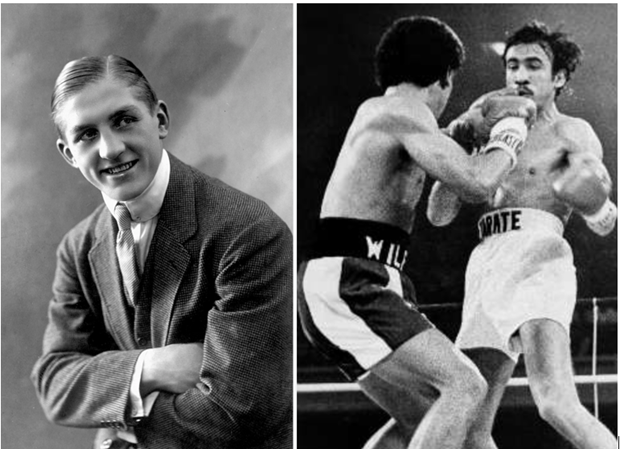
Boxing has always been a sport of moments — flashes of courage, heartbreak, and glory that echo long after the bell. On October 28, two very different stories share the same date on the calendar: the passing of Georges Carpentier, France’s “Orchid Man,” and the night in 1978 when Wilfredo Gómez cemented his legend by dismantling Carlos Zárate in front of a roaring Puerto Rican crowd.
Georges Carpentier: Regional Champion to Cultural Icon
Georges Carpentier wasn’t just a boxer — he was a bridge between eras. Born in Lens, France, in 1894, he laced up gloves before most boys his age finished school. By 19, he had already captured European titles from welterweight to heavyweight, a feat that earned him fame across the continent.
Carpentier fought with an elegant violence. He moved like a fencer, quick and calculating, blending grace with grit. But what made him unforgettable wasn’t just his technique — it was his willingness to take risks. In 1920, he knocked out Battling Levinsky to become the world light-heavyweight champion. A year later, he dared to do the unthinkable: challenge the fearsome Jack Dempsey for the heavyweight crown.
That bout, held in Jersey City on July 2, 1921, was more than just a boxing match — it was a cultural event. With a record-breaking gate of over one million dollars, it turned boxing into big business. Carpentier fought bravely but was overpowered, stopped by Dempsey in the fourth round.
Outside of boxing, Carpentier’s life was no less colorful. A decorated World War I pilot, he was awarded France’s Croix de Guerre. After hanging up his gloves, he became a celebrity — appearing in films, performing on stage, and running his Parisian restaurant, Chez Georges Carpentier, a haunt for artists and athletes alike.
When he passed away on October 28, 1975, at age 81, France didn’t just lose a sportsman; it lost a symbol of courage, charm, and class.
When San Juan Erupted: Gómez vs. Zárate
On October 28, 1978, at The Roberto Clemente Coliseum in San Juan, Puerto Rico, two undefeated champions stood in the ring: Puerto Rico’s pride, Wilfredo Gómez (21-0-1, all wins by knockout), and Mexico’s relentless Carlos Zárate (52-0, 51 KOs).
The stakes were enormous — the WBC super-bantamweight title and national bragging rights in the sport’s fiercest rivalry: Puerto Rico vs. Mexico.
From the opening bell, Gómez fought with the precision of a surgeon and the fury of a storm. Zárate, moving up in weight, found himself facing an opponent who matched his power and exceeded his speed. In the fourth round, Gómez’s counters began to land with force. A right hand sent Zárate crashing to the canvas. Moments later, another knockdown — and the Puerto Rican crowd exploded.
Gomez opened the fifth round aggressively, landing three successive hooks to Zárate’s head. He then trapped Zárate on the ropes, connected with a right-hand and followed with a powerful left-hook that buckled Zárate’s knees. Zárate went down for a third time (second official knockdown) in the fight, and as he tried to rise, Gómez landed an additional straight right hand. Zárate’s corner threw in the towel, and the referee stopped the fight less than a minute into the round, awarding Gómez the win by TKO.
Gómez’s victory wasn’t just dominant — it was symbolic. Puerto Rico had triumphed, and a new superstar had been born. Puerto Rico vs. Mexico has long been more than a matchup; it is a tradition of pride, passion, and punishment that continues through generations of fighters.
October 28th in Boxing History
October 28 stands as a kind of mirror in boxing history. On one side, Georges Carpentier — the gentleman gladiator, a pioneer who carried boxing into the modern era. On the other, Wilfredo Gómez — the ruthless artist whose fists wrote poetry in motion and defined Puerto Rican excellence.
Separated by decades but united by courage, both men embody what makes boxing timeless: the pursuit of greatness, the defiance of odds, and the ability to captivate the world from inside three ropes.
As history reminds us, some nights in boxing aren’t just about who wins — they’re about what endures.




Agit Kabayel Rallies to Stop Damian Knyba, Claims Interim WBC Heavyweight Title

Early 2026: Boxing Results and Emerging Storylines

Celebrating Mike Ayala on his Birthday

Avila Perspective Chap 359 Heavyweights, Super Lights and More

Artur Beterbiev: Power, Persistence, and the Pursuit of Boxing Immortality

This Week’s Birthdays in Boxing: Three Heavyweights, Three Paths

Celebrating Roy Jones Jr. and Matt Godfrey on Their Birthday

Joe Frazier: The Relentless Heart of a Heavyweight Legend

The Boxing Landscape This Week: Results, Rumors, and What’s Next

Muhammad Ali and Oleksandr Usyk: Same Day, Different Worlds

This Week in Boxing

Remembering Salvador Sánchez, Boxing’s Unfinished Masterpiece

George Godfrey: The Leiperville Shadow — The Uncrowned King of Heavyweight Boxing

Muratalla Retains IBF Lightweight Crown With Majority Decision Over Cruz

Callum Walsh Cruises Past Ocampo as Zuffa Boxing Launches in Las Vegas

Champion Lupe Aquino

Ryan Garcia and Mario Barrios Meet in Hollywood

Nigel Benn: The Dark Destroyer

Avila Perspective Chap 361 Las Vegas is Back in Boxing … and More
Artur Beterbiev: Power, Persistence, and the Pursuit of Boxing Immortality

-

 Featured Articles4 weeks ago
Anthony Joshua Discharged from Hospital After Fatal Nigeria Car Crash — Latest Updates
-
 Featured Articles4 weeks ago
December 31: This Day in Boxing History — Legends Were Tested and Titles Changed Hands
-

 Featured Articles3 weeks ago
Amanda Serrano Wins Action-Packed Decision and Other MVP fight results
-
 Featured Articles2 weeks ago
Agit Kabayel Rallies to Stop Damian Knyba, Claims Interim WBC Heavyweight Title
-

 Featured Articles4 weeks ago
Anthony Joshua Injured in Fatal Car Crash in Nigeria
-
 Featured Articles2 weeks ago
Early 2026: Boxing Results and Emerging Storylines
-
 Featured Articles4 weeks ago
Emanuel Augustus: Boxing’s Unconventional Craftsman
-

 Featured Articles4 weeks ago
Avila Perspective Chap 358: Boxing – The Best of 2025