Featured Articles
December 25: This Day in Boxing History – Sugar Ray Robinson’s Christmas Day Fight

December 25: This Day in Boxing History – Sugar Ray Robinson’s Christmas Day Fight
Christmas Day is rarely associated with prizefighting in the modern era, but boxing’s historical record tells a different story. In the early and mid-20th century, December 25 was not off-limits to the sport’s biggest names, particularly during periods when boxing functioned as both mass entertainment and a global touring enterprise. Among the most significant bouts ever staged on Christmas Day was one involving the sport’s greatest practitioner, fought far from home, amid the geopolitical aftershocks of World War II.
Sugar Ray Robinson vs. Hans Stretz
December 25, 1950 — Frankfurt, West Germany
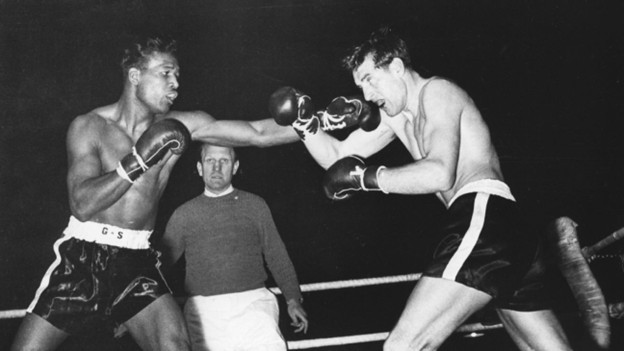
On December 25, 1950, Sugar Ray Robinson, already widely regarded as the finest boxer of his generation, stopped German middleweight Hans Stretz in the fifth round at Frankfurt’s Messehalle. The bout was a non-title contest, but its context elevated it well beyond an exhibition. Robinson entered the ring as the reigning world welterweight champion and the sport’s undisputed pound-for-pound standard, extending one of the most remarkable unbeaten runs in boxing history.
The fight was staged before an estimated crowd of roughly 10,000 spectators, including large numbers of American military personnel stationed in Germany as part of the post-war occupation. Contemporary reporting noted that Robinson arrived in Frankfurt on Christmas Eve by train, greeted by U.S. servicemen who viewed the bout as a rare holiday spectacle. It is widely believed to have been the first time a reigning world champion fought professionally in Germany, a country still rebuilding after the war.
Robinson’s appearance on Christmas Day was part of an extraordinary European tour in 1950, during which he fought across multiple countries. The schedule, nearly unimaginable by modern standards, reflected both Robinson’s global appeal and the era’s economic realities. He traveled with an unusually large entourage and more than 50 pieces of luggage, emphasizing his status as a major international attraction at a time when few American champions routinely boxed overseas.
Inside the ring, Robinson showed little sentimentality for the occasion. He systematically broke down Stretz before ending the bout with a decisive fifth-round stoppage, further extending a winning streak that would ultimately reach 91 consecutive bouts. Despite earning substantial purses during the tour, Robinson later acknowledged that the costs of constant travel and maintaining his entourage left him with little to show financially.
Boxing on Christmas Day: A Vanishing Tradition
Robinson’s Christmas Day bout marked a transitional moment in boxing history. Before World War II, December 25 cards were relatively common in major boxing centers, particularly in the United States and parts of Europe. Fighters such as Benny Leonard, Harry Greb, Kid Chocolate, Jack Britton, and Tommy Loughran all appeared on documented Christmas Day programs earlier in the century. By the post-war era, however, changes in promotional strategy, labor expectations, and broadcast scheduling rendered the practice increasingly rare.
That makes Robinson’s 1950 appearance especially notable. It stands as one of the last major professional bouts staged on Christmas Day involving a reigning world champion.
A Holiday Footnote with Lasting Weight
December 25 acts as a reminder of when champions traveled relentlessly, fought frequently, and carried boxing into places where it still served as a shared public event. Robinson’s victory in Frankfurt remains the clearest example; a Christmas night bout that reflected boxing’s global reach, its physical demands, and it’s difficult balance between sacrifice and recognition.