Featured Articles
This Day in Boxing History: Klitschko Controls Chisora in Munich

This Day in Boxing History: Klitschko Controls Chisora in Munich
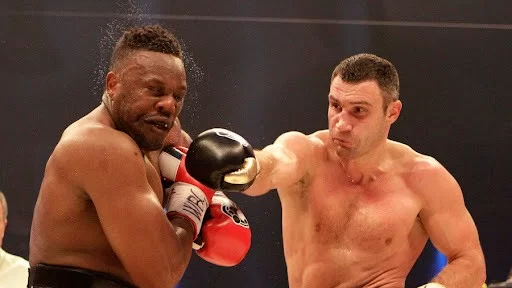
On February 18, 2012, at Munich’s Olympiahalle, Vitali Klitschko retained the WBC heavyweight championship with a unanimous decision over Derek Chisora, who came into the fight sporting a 15-2 record. After twelve rounds, the official scores were 118–110 (2x) and 119–111.
The bout concluded a volatile fight week. At the weigh-in, Chisora slapped Klitschko across the face. Hours before the opening bell, he spat water toward his brother Wladimir Klitschko during the ring introductions. The incidents resulted in fines from the WBC and generated widespread coverage from the media, shifting attention from strategy to spectacle well before the first punch was even thrown.
Inside the ring, however, the contest unfolded in familiar fashion for Klitschko. Using his reach and a disciplined, authoritative jab, he controlled distance and neutralized much of Chisora’s inside work. CompuBox statistics reflected that control: Klitschko landed 134 of 347 punches (39%), compared to Chisora’s 104 of 395 (26%). Chisora pressed forward and targeted the body, yet he struggled to consistently close distance against a champion who relied on positioning and leverage.
At 40 years old, Klitschko was making his eighth defense of the WBC title in his second reign. He had regained the belt in 2008 with a stoppage of Samuel Peter and subsequently turned back a series of challengers during a period of heavyweight stability under the Klitschko era.
While the Munich fight marked one of the defining late-career moments for Klitschko, he would return later that year on September 8, 2012 to defend his WBC heavyweight crown against Manuel Charr, stopping him in the fourth round due to cuts. That contest would prove to be Klitschko’s final professional bout. Klitschko announced his retirement in December 2013 with a record of 45–2 (41 KOs), later transitioning fully into Ukrainian politics and eventually becoming mayor of Kyiv.
For Chisora, the loss dropped his record to 15–3 and ignited one of the most chaotic stretches of his career. At the post-fight press conference in Munich, a heated exchange with former WBA heavyweight titleholder David Haye escalated into a physical altercation involving members of both camps. The confrontation led to investigations by German authorities and a disciplinary review by the British Boxing Board of Control (BBBofC).
Within days, the two agreed to settle matters in the ring. Because Haye did not hold a British license at the time and Chisora’s license was subsequently suspended pending a hearing, the February 25 bout at London’s Upton Park proceeded under the jurisdiction of the Luxembourg Boxing Federation. The regulatory shift allowed the contest to move forward on short notice. Chisora had not sustained significant physical damage in Munich (completing twelve rounds without a knockdown), and medical clearance enabled the unusually quick turnaround. Commercial momentum from the altercation did the rest.
The gamble proved costly for Chisora, with Haye stopping him in the fifth round.
More than a decade after Munich, Chisora remains active on the elite stage and is now scheduled to meet former WBC heavyweight champion Deontay Wilder. Wilder, long regarded as one of the division’s most concussive punchers, built his title reign on erasing deficits with single right hands, recording 42 knockouts in his first 43 victories. Though recent years have brought setbacks and questions, his power remains the defining variable in any matchup.
For Chisora, the contest fits a familiar pattern: high-risk opposition, physical engagement, and the willingness to test his durability against elite-level force. Wilder operates at range, probing with a measured jab while waiting to uncork his right hand. Chisora typically applies forward pressure, works the body, and attempts to turn fights into close-quarters exchanges. The question is whether Chisora can consistently close distance without absorbing the type of clean, long-range power that has defined Wilder’s career.
The fight carries implications for relevance in a heavyweight division that remains in flux. For Wilder, it is an opportunity to reaffirm contender status. For Chisora, it is another chance to reinforce his reputation as a durable, marketable veteran still willing to face dangerous opposition deep into his career. More than a decade removed from Munich, he continues to position himself as an active heavyweight willing to take chances.
And as for Vitaly Klitschko, if you started naming the greatest heavyweights of all time, it wouldn’t take you very long to get to his name.
To comment on this article in the Fight Forum, please CLICK HERE.