Featured Articles
December 26: This Day in Boxing History — Jack Johnson, Muhammad Ali, and Global Heavyweight Legacy

December 26: This Day in Boxing History — Jack Johnson, Muhammad Ali, and Global Heavyweight Legacy
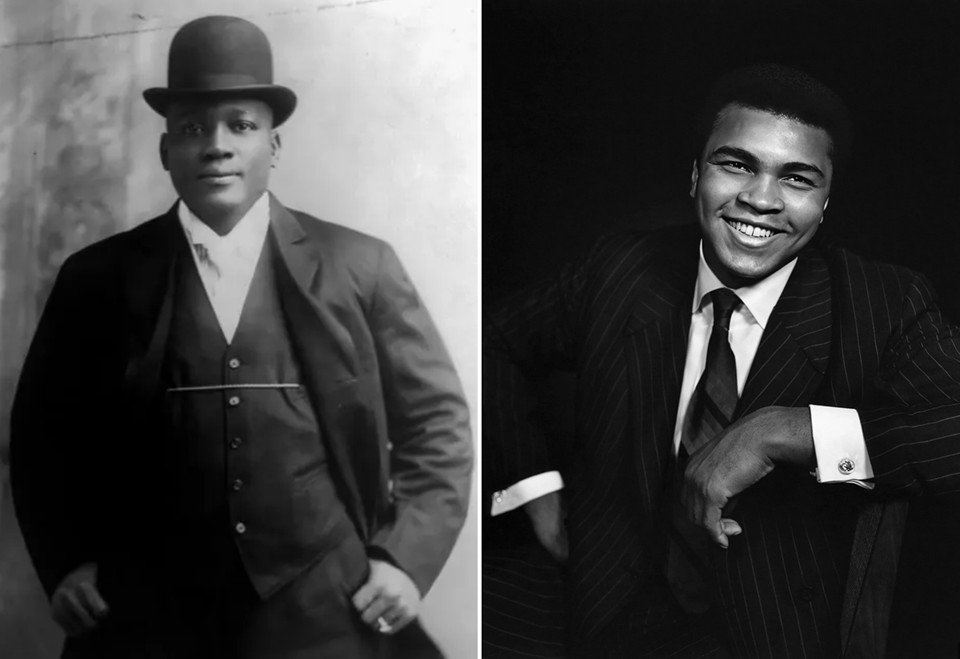
December 26 occupies a distinctive place in boxing history, marked by two heavyweight fights that unfolded more than six decades apart yet shared a common thread: each reflected boxing’s global reach and its ability to intersect with far larger cultural currents. On this date in 1908, Jack Johnson shattered the sport’s most entrenched barrier by claiming the world heavyweight title in Australia. In 1971, Muhammad Ali closed out the year with a decisive stoppage in Germany, reaffirming his place atop the heavyweight division during one of the most politically and commercially complex periods of his career.
Jack Johnson Defeats Tommy Burns — December 26, 1908 (Sydney, Australia)
On December 26, 1908, Jack Johnson faced Tommy Burns faced Jack Johnson. Burns weighed 168 for the fight and was paid $30,000; Johnson weighed in at 194 and his purse was $5000. Both combatants wore 4 ounce gloves, and Burns entered the bout a 1.5 to 1 favorite. Burns won by 14th-round technical knockout in a fight scheduled for 20 rounds at Sydney Stadium in Rushcutters Bay to become the first Black world heavyweight champion in boxing history. The fight was halted by police intervention as Johnson dominated Burns, and referee Hugh McIntosh awarded Johnson the victory, officially ending Burns’ title reign. It should be noted that McIntosh was also the promoter of record.
The bout was one of the most heavily anticipated sporting events Australia had seen at the time. Contemporary reports estimate that roughly 20,000 spectators packed the open-air venue, with additional onlookers climbing trees, fences, and nearby structures just to catch a glimpse. Burns, who had previously refused to face Johnson, agreed to the fight only after receiving one of the largest guarantees of the era, highlighting both the financial stakes and the racial tensions surrounding the match-up.
Johnson’s victory reverberated far beyond boxing. It dismantled the heavyweight division’s informal color line and ignited an international search for a so-called “Great White Hope” to reclaim the title. Portions of the fight were captured on early motion picture film, making it one of the earliest heavyweight championship bouts preserved on camera. More than a century later, the fight’s location has been commemorated in Sydney, reflecting its lasting cultural and sporting significance.
Muhammad Ali Stops Jürgen Blin — December 26, 1971 (Zurich, Switzerland)
On December 26, 1971, in Zurich, Switzerland, fourteen months after coming out of a forced retirement, Ali stopped Germany’s Jurgen Blin at 2:12 of the seventh round of a scheduled twelve. The bout came during a transitional phase in Ali’s career, as he remained one of the sport’s most recognizable figures while navigating the aftermath of his ring exile and the evolving heavyweight landscape of the early 1970s.
Ali controlled the fight with his trademark combination of speed, footwork, and volume before ending matters in the seventh round. The stoppage marked the first time Blin had been knocked out in his professional career. Although Blin entered as a heavy underdog, the opportunity to face Ali elevated his profile in Europe; he would go on to win the European heavyweight title the following year.
The economics of the bout reflected the widening financial gap at the sport’s highest level. Ali reportedly earned approximately $200,000 for the fight, while Blin’s purse was a fraction of that sum at $45,000. For Ali, the contest served as both a confidence-building victory and a continuation of his extensive international schedule, reinforcing boxing’s global pull during an era when heavyweight champions regularly headlined events across continents.
A Date Defined by Global Impact
Jack Johnson’s triumph in Australia reshaped the heavyweight division and challenged deeply rooted social barriers, while Muhammad Ali’s post-Christmas victory in Europe highlighted the sport’s expanding international economy and enduring star power.
Separated by decades but linked by influence, these bouts reflect how boxing history is often forged far from home, under circumstances that extend well beyond the ropes — and why December 26 remains a date worth remembering in the sport’s long, complex timeline.