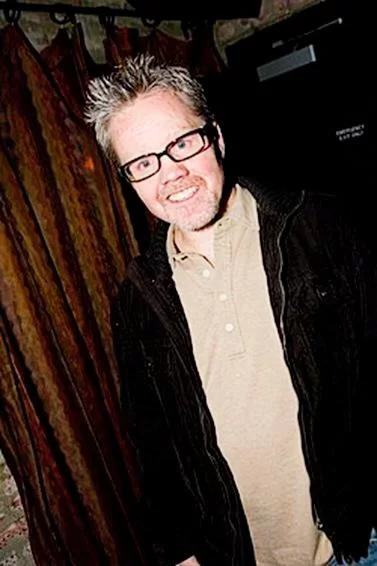
On March 5, 1960, in Dedham, Massachusetts, Frederick “Freddie” Steven Roach was born into a household where boxing was a way of life. His father, Paul Roach, had been a fighter and later became a trainer who introduced his sons to the routines and discipline of the gym at an early age. His mother, Barbara Roach, would later become the first female boxing judge in Massachusetts. The gym part of daily life, a place where lessons about discipline and accountability were absorbed almost by instinct.
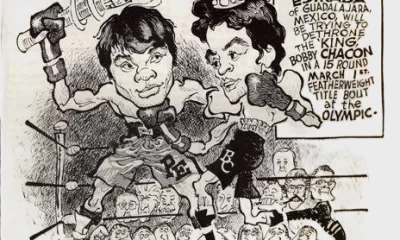
Roach turned professional in 1978 and competed primarily as a junior lightweight during the cable-television boxing boom of the early 1980s. When his career concluded in 1986, his official record stood at 40 wins and 13 losses with 15 knockouts. He was a rugged, determined fighter who faced quality opposition, including future International Boxing Hall of Famer Héctor Camacho (Class of ’16), former world champion and future International Boxing Hall of Famer Bobby Chacon (Class of ’05), and future world champion Greg Haugen. His bouts were fought with a straightforward intensity that reflected the lessons he learned under his trainer Eddie Futch. Roach earned the respect of those who understood the sport.
Futch’s influence on Roach cannot be overstated. One of the most respected strategists in boxing history, Futch believed in disciplined fundamentals and thoughtful adaptation inside the ring. He recognized in Roach a student of the game as much as a practitioner. The young fighter listened and learned. He studied angles and paid attention to the subtle mechanics of offense and defense. Those observations would later form the foundation of Roach’s approach as a trainer.
Toward the end of his time in the ring, Roach began showing symptoms that would later be associated with Parkinson’s disease. Futch, concerned about his fighter’s health, advised him to retire. Roach was only twenty-six years old when he stepped away from professional boxing. Like many fighters whose careers conclude sooner than expected, he faced the difficult task of redefining his life outside the ropes.
The transition was not immediate. Roach spent time in Las Vegas working ordinary jobs before reconnecting with Futch, who invited him to assist in training fighters. For roughly five years Roach worked alongside his former mentor. The apprenticeship allowed him to observe how great trainers read a fighter’s temperament, corrected flaws, and structured preparation for different opponents. It was during this period that Roach began shaping the philosophy that would eventually define his career.
In 1995, Roach opened the Wild Card Boxing Club in Hollywood with help from his brother Pepper. The gym began modestly, and over time Wild Card became one of the most recognizable training centers in the sport.
“Inactivity is the biggest sin in boxing,” Roach once remarked, reflecting his belief that while in the gym, one should stay busy doing sit-ups, push-ups, skipping rope, etc. Just don’t be idle.
Roach’s training philosophy emphasized controlled aggression. He believed that effective offense was built on preparation and structure rather than reckless attack. Fighters under his guidance learned to combine punches in sequence, move laterally after striking, and maintain a pace that forced opponents to go on the defensive.
The resume grew, Roach and the Wild Card began attracting elite fighters, but the defining partnership of Roach’s career started in 2001 when Manny Pacquiao walked into the Wild Card gym. Pacquiao was already a talented and dangerous southpaw with exceptional speed, yet Roach believed his style could be refined and expanded. Under Roach’s guidance, Pacquiao developed more sophisticated combinations, improved footwork, and a devastating right hook that complemented his famous left hand. The result was one of the most successful collaborations in boxing history. Pacquiao would go on to win world lineal titles in eight weight divisions, an unprecedented accomplishment that placed both fighter and trainer among the sport’s most influential figures.
Roach’s reputation grew accordingly. Over the years he trained numerous champions and high-profile fighters, including Miguel Cotto, Amir Khan, James Toney, Oscar De La Hoya, and Mike Tyson during their careers. His fighters were often characterized by high punch output, sharp offensive timing, and a willingness to press the action. Yet beneath that reputation for aggressive tactics was a deeper understanding of ring intelligence, the idea that offense, when structured correctly, can function as a form of defense by forcing opponents into reactive positions.
Throughout these years Roach lived openly with Parkinson’s disease, a condition that affects his speech and movement but has never driven him away from boxing. Instead, the sport has remained central to his daily routine. The constant activity of training, holding mitts, instructing fighters, and supervising workouts, has helped him manage the illness while doing what he loves. Roach has frequently spoken about the role boxing plays in his life, explaining simply, “Boxing keeps me going.”
In many ways Freddie Roach’s life has been defined by persistence. As a fighter he endured difficult bouts and learned from defeat. As a trainer he built a gym from modest beginnings and helped shape the careers of world champions. As a man confronting Parkinson’s disease, he chose not to retreat from the sport that defined him but to remain fully engaged with it.
Roach was rightfully inducted into the International Boxing Hall of Fame in 2012. He is the trainer who carefully watches as his fighters move through their drills. When he holds the focus mitts, his eyes remain fixed on the rhythm of the punches, correcting distance, timing, and foot placement with practiced precision, as he guides his fighter through the difficult and nuanced craft he once practiced himself.
Happy 66th, Trainer of Champions and a Champion in your own right.
To comment on this article in the Fight Forum, please CLICK HERE