Featured Articles
George Godfrey: The Leiperville Shadow — The Uncrowned King of Heavyweight Boxing

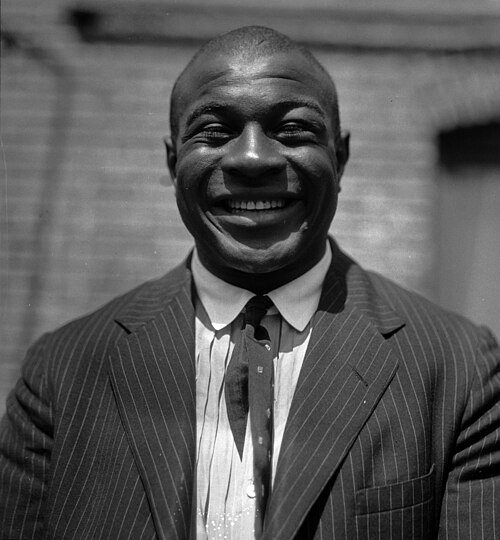
George Godfrey: The Leiperville Shadow — The Uncrowned King of Heavyweight Boxing
In the pantheon of early heavyweight boxing, some of the most awe-inspiring figures never held the championship they deserved. Among them stands George Godfrey, a giant of his era whose life and legacy reveal both the brutality of the sport and the social barriers that kept some of its greatest stars from the throne. Born Feab S. Williams* on January 25, 1897, in Mobile, Alabama, Godfrey would rise from modest beginnings to become one of the most feared and accomplished heavyweights of the period; yet never officially recognized as a world champion.
*There is a discrepancy as to if the “S” stood for Smith or Sylvester
Beginnings and the Making of a Heavyweight Force
Williams took the ring name George Godfrey in homage to an earlier Black boxing pioneer, Canadian fighter George “Old Chocolate” Godfrey (who got his nickname in the later portion of his career). As the modern heavyweight era dawned, Williams sought to carry on that legacy amid a racially divided sport that frequently barred Black fighters from the championships. Standing 6-foot-3 with a nearly 80-inch reach, he was a physically imposing figure for his time, combining strength, reach, and punching power that made him a nightmare for opponents.
Godfrey’s professional career formally began on December 1, 1919, when he scored a first-round knockout of Eddie Jamison, launching a pro tenure that would extend until 1937 and include well over 100 fights.
Confronting Greats and Racial Barriers
Godfrey’s early years were not smooth. His second pro fight was a 10-round draw against future Hall of Famer Sam Langford, who came into the bout with over 200 professional fights on his record. Langford was a smaller but highly skilled slugger whom more than one boxing historian believed to be the best pound for pound fighter ever. Godfrey suffered knockouts in subsequent rematches with Langford in 1920 and 1921.
Throughout the 1920s, Godfrey shared the ring with many top contenders of his era. He put fear into hard-hitting heavyweights like Fred Fulton and Bill Tate and demonstrated versatility by outpointing solid challengers like Paolino Uzcudun, who entered the bout with a record of 32-4-2. But despite his skills and credentials, the color line (a racial barrier in boxing that kept Black fighters from contending for the “official” world heavyweight title) blocked his path to a title.
The World Colored Heavyweight Champion
Denied access to the universally recognized world title, Black heavyweights of the early 20th century often competed for the unofficial but deeply respected World Colored Heavyweight Championship. Godfrey captured this honor first on November 8, 1926, when he defeated Larry Gains by a sixth-round TKO in Buffalo, New York. He defended the title multiple times.
Godfrey later lost the title back to Larry Gaines on August 15, 1928, due to being disqualified for a low blow. He recaptured the colored crown again in 1931 with a second-round knockout in a scheduled to against Seal Harris in Toronto. Godfrey was known as one of the most powerful and consistent heavyweights of his generation.
International Success and Controversy
In 1935 in Brussels, Belgium, Godfrey claimed the vacant International Boxing Union (IBU) World Heavyweight Title with a fifteen-round decision over Belgian contender Pierre Charles.
One of the most controversial moments of his career occurred in the June 6, 1930 bout against future world champion Primo Carnera in Philadelphia. Godfrey was reportedly winning when he was disqualified in the fifth round for a low blow (a decision that many historians have scrutinized as suspect), leading to a suspension and lost purse that temporarily stalled his U.S. career.
A Career of Power and Persistence
Over nearly two decades, Godfrey proved himself a heavy hitter and tireless competitor. Records compiled by historical archives show a career tally often cited around 99 wins, 21 losses, and 2 draws, with knockouts accounting for a staggering 81 victories.
While the exact totals vary slightly among sources, one consistent truth remains: Godfrey was a prolific and powerful heavyweight. Contemporary accounts describe him as a strong fighter, both physically and mentally.
Life Beyond the Ring
Despite his achievements, the barriers of his time prevented Godfrey from achieving what many believed he deserved: a shot at the undisputed world heavyweight title. Segregation in boxing and broader society limited the horizons of many Black athletes, no matter how dominant or skilled.
After retiring in 1937, Godfrey’s legacy continued to grow, buoyed by historians and sportswriters who acknowledged his contributions to the sport. In 2007, more than half a century after his death, he was inducted into the International Boxing Hall of Fame, a long-overdue honor.
Remembering a Black King of the Ring
George Godfrey passed away at age 50 on August 13, 1947, in Los Angeles, California, leaving behind a record that defied societal barriers.
On his birthday, we honor George Godfrey.
To comment on the article in the Fight Forum, please CLICK HERE