About Us
Israel Vázquez and Tod Morgan, Separated by Eras, United by Endurance

Israel Vázquez and Tod Morgan, Separated by Eras, United by Endurance
December 25 has produced two champions who, in different centuries and under radically different conditions, came to represent the deepest virtues of the the sweet science.
Israel Vázquez and Tod Morgan were born seventy-five years apart, one in Mexico City’s modern sprawl, the other in the industrial Pacific Northwest of the early 1900s. Their careers unfolded in different weight classes, under different rules, before different audiences. Yet both men built legacies not merely on titles, but on durability, professionalism, and a willingness to meet boxing on its hardest terms.
On December 25, the sport honors two fighters whose greatness was earned round by round.
Israel Vázquez — Courage as a Calling
Israel Vázquez was born December 25, 1977, in Mexico City, a place where boxing has long functioned as both trade and tradition. Turning professional in 1995, Vázquez climbed patiently through Mexico’s dense domestic scene, forging his reputation through consistent, punishing performances.
By the early 2000s, Vázquez had emerged as one of the world’s premier super bantamweights. In 2004, he captured the IBF 122-pound title, later adding the WBC version, becoming a unified champion in one of boxing’s most talent-rich divisions. His style was pressure-heavy, body-focused, technically sound, and it reflected the classic Mexican blueprint, but without theatrical excess. Vázquez was not a showman. He was a craftsman.
His legacy, however, would be defined by rivalry.
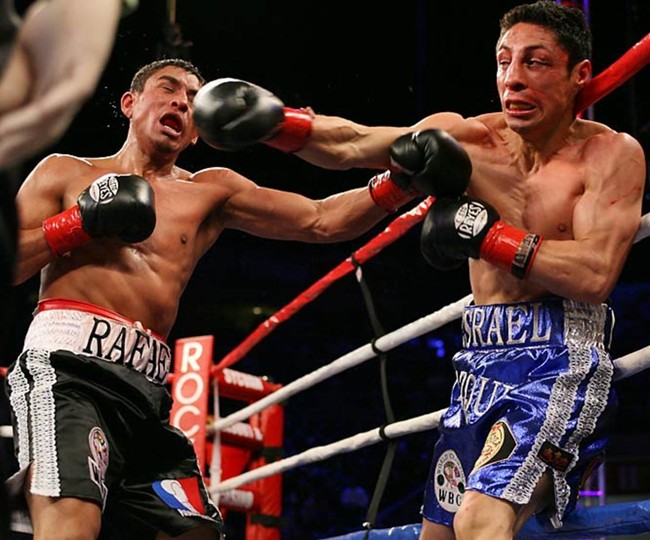
Between 2007 and 2010, Vázquez fought Rafael Márquez four times, a series that now occupies sacred ground in modern boxing history. Their second and third fights were named Fight of the Year by The Ring. These were not simply violent contests; they were tactical wars waged at all cost. Vázquez won two of the four bouts, including a dramatic stoppage victory in their first encounter, before their rivalry ended with both men permanently marked by the experience.
The cost was real. Vázquez suffered severe eye injuries during the series, eventually forcing his retirement in 2010. His professional record (44-5 with 32 KOs) tells only part of the story. Vazquez wanted to be remembered as a legend; a wish that, in some boxing circles, has been fulfilled.
After boxing, Vázquez lived quietly, his post-career life shaped by health challenges stemming from ring damage. Yet his standing within the sport only grew. Fighters speak of him with reverence. Fans remember him as a champion who defined an era.
Israel Vázquez is a champion who honored boxing through craft and resolve.
On a somber note, Israel left us much too early as he passed on December of 2024 at the age of forty-six. RIP Champ.
Tod Morgan — Mastery Before the Spotlight

Tod Morgan was born December 25, 1902, in St. Louis, Missouri, but came of age as a fighter in Washington State, where boxing was still carving its professional identity. He turned professional in 1920, entering a sport that demanded volume, versatility, and relentlessness. Champions fought often. Defenses were frequent. Careers were built on accumulation.
Morgan thrived in that environment.
In 1925, he won the world junior lightweight (super featherweight) championship, a title he would hold for nearly four years which was an eternity by the standards of his time. During his reign, Morgan made more than a dozen successful defenses, defeating top contenders across the country and abroad. His style was technical, economical, and disciplined, relying on footwork and timing rather than brute force.
He fought everyone available. He traveled. He defended. And he rarely lost.
By the time Morgan retired in 1933, he had compiled a staggering record: 132 wins, with just 42 losses and 34 draws, across nearly 180 professional bouts. In an era before television contracts and modern marketing, Morgan’s reputation rested entirely on consistency and credibility. He was widely regarded by contemporaries as the finest junior lightweight of his generation.
Unlike many fighters of his era, Morgan transitioned successfully into life after boxing. He worked steadily, remained respected within his community, and avoided the public unraveling that followed so many early-20th-century fighters. In 1969, he was inducted into the International Boxing Hall of Fame, recognition long overdue for a champion whose greatness was quiet but undeniable.
Morgan passed away in 1986, leaving behind a record that remains one of the most substantial in divisional history based on of sustained excellence.
A Shared Birthday, A Shared Truth
Israel Vázquez and Tod Morgan were never a part of each other’s worlds. One fought under bright lights and pay-per-view pressure; the other boxed in smoke-filled halls before newspaper men and local commissions. But both lived by the same professional code: fight the best, fight often, and let the record speak for itself.
They remind us that boxing history is built on men who return to the ring again and again, who accept risk as part of craft, and who leave behind something lasting other than championship belts, but standards and reputation.
On December 25, boxing remembers two champions who gave the sport substance, heart and respect..