Featured Articles
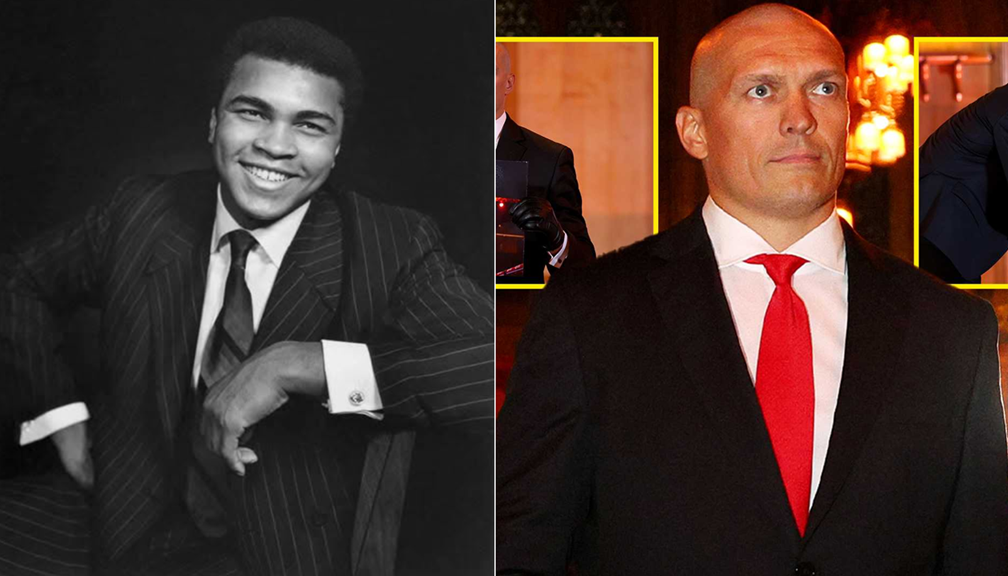
Muhammad Ali and Oleksandr Usyk: Same Day, Different Worlds

Muhammad Ali and Oleksandr Usyk on War, Conscience, and the Heavyweight’s Burden
Boxing history rarely offers symmetry this precise. Muhammad Ali and Oleksandr Usyk, born forty-five years apart on January 17, share a birthday, a division, Olympic gold medals, and even identical physical dimensions. Yet almost everything else about them appears to be the opposite: race, nation, stance, hemisphere, and historical moment. And still, when war entered their lives, each man was confronted with the same elemental question that only heavyweight champions seem forced to answer: what, if anything, does the world’s most visible fighter owe when history makes its demand?
They Couldn’t be More Different…
Ali emerged from segregated Louisville, Kentucky, a prodigious talent shaped more by cadence, instinct, and lived experience than by classroom. He graduated from Central High School with a D- average and ranked near the bottom of his class. These facts were often weaponized by critics eager to mistake formal schooling for intellect.
Usyk’s beginnings could hardly be more different. Raised in post-Soviet Ukraine, he progressed through structured amateur systems that valued discipline, preparation, and education. He earned advanced degrees in psychology and law, credentials that align neatly with his methodical, cerebral approach inside and outside the ring.
Ali was Black; Usyk is white.
Ali fought orthodox; Usyk is a southpaw.
Ali was Western Hemisphere; Usyk Eastern.
Even their public perceptions diverged. Ali was once dismissed as brash, undisciplined, even unserious. Usyk has been described as analytical, spiritual, almost monk-like. On paper, they appear to occupy opposite ends of the heavyweight spectrum.
…Or More Alike
Scratch beneath the surface, however, and the parallels become unmistakable.
Both won Olympic gold medals; Ali in Rome in 1960, Usyk in London in 2012. Both stand 6’3″ with 78-inch reaches. Both rose to the heavyweight summit without conforming to the prevailing stylistic norms of their eras. And both, unusual for champions of their size and stature, are poets. They are men who understand language as a weapon, a shield, and a bridge to their people.
Most importantly, both developed a profound sense of responsibility that extended far beyond belts and purses.
For Ali, that burden arrived in the form of a draft notice.
Ali and the War he Refused
Ali rejected the contradiction of fighting for freedoms overseas that Black Americans were denied at home; fully aware that his value to the war effort would be not as a combatant, but as a figurehead in the mold of Joe Louis.
He understood the machinery. Joe Louis had served honorably, lent his image to the cause, toured bases, and symbolized American unity; while returning to a country still steeped in segregation. Ali saw that path clearly and declined it, choosing conscience over compliance.
The cost was enormous. He lost his heavyweight title, nearly four prime years of his career, millions in earnings, and endured public scorn that now seems almost unimaginable. Yet during that exile, Ali acquired an education no transcript could capture. Navigating legal battles that culminated in a Supreme Court victory, fighting for reinstatement across hostile commissions, and surviving as the most scrutinized athlete in the world, Ali became a master of psychology, rhetoric, and law by necessity.
If Usyk arrived at wisdom through classrooms and credentials, Ali arrived there through consequence; via years of public scrutiny and legal peril that amounted to a graduate education conducted on the world’s largest stage.
Usyk and the War he Could not Avoid
Usyk faced no such abstraction. When Russia invaded Ukraine, the war came to him—uninvited, immediate, and existential. He returned home, joined territorial defense efforts, and made clear that his identity as a citizen preceded his status as a champion.
Eventually, Usyk returned to boxing, but not as an escape. His fights became extensions of national presence; proof that Ukraine still stood, still produced champions, still spoke to the world. Where Ali’s resistance was expressed through refusal, Usyk’s was expressed through visibility.
Different wars demanded different answers.
The Heavyweight’s Burden
Ali and Usyk are not opposites; they are parallel solutions to different moral equations. Ali asked what he owed his soul. Usyk asked what he owed his people. Both answered honestly, and both accepted the consequences.
History has already softened Ali’s defiance into legend. Usyk’s story is still being written, its full cost not yet tallied. But on this shared birthday, the connection is clear—not in style or circumstance, but in gravity.
Ali and Usyk faced different wars, but shared the same burden: deciding what a heavyweight champion owes when history calls his name.
To comment on this article in the Fight Forum, please CLICK HERE.