Featured Articles
On This Day in Boxing History: Notable Fights and Facts

On This Day in Boxing History: Notable Fights and Facts
December 2 carries a distinct legacy. From a late 1800s controversy to a 21st-century welterweight title defense, December 2 offers a narrow but meaningful snapshot of boxing’s evolution.
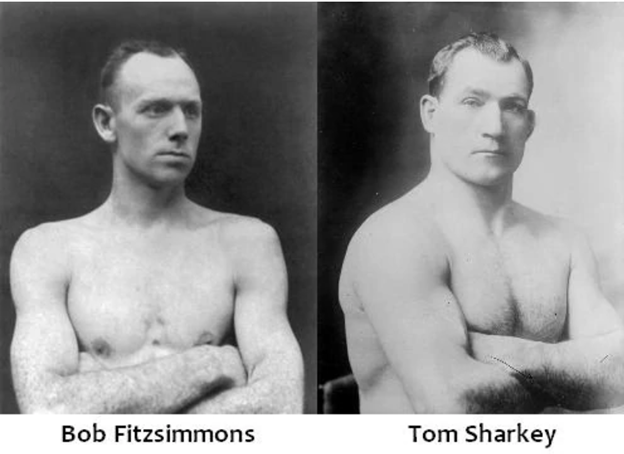
Bob Fitzsimmons vs Tom Sharkey (1896)

The most storied of these is the 1896 heavyweight contest between Bob Fitzsimmons and Tom Sharkey in San Francisco. What should have been a clear step toward crowning a new heavyweight champion instead turned into one of the earliest major officiating scandals in boxing history. Fitzsimmons controlled the action, scored a knockdown in the eighth round, and appeared on the verge of victory until referee Wyatt Earp ruled that the blow had landed illegally and disqualified Fitzsimmons on the spot. The ruling was met with immediate skepticism from the crowd and later by reporters. Even today, the outcome is generally viewed as illegitimate, emblematic of a period when refereeing, rulesets, and governance were still inconsistent across jurisdictions.
Tommy Burns vs Gunner Moir (1907)

A decade later, on December 2, 1907, the heavyweight title was once again on the line, this time under far more organized circumstances. Tommy Burns, the Canadian world champion, defended his title against Gunner Moir in London. Burns stopped Moir in the tenth round and retained his belt in what became one of the early examples of the heavyweight championship being contested outside the United States.
Antonio Margarito vs Joshua Clottey (2006)

On December 2, 2006, Antonio Margarito faced Joshua Clottey. Margarito, then the WBO welterweight champion, defended his title by unanimous decision in a fight defined by pace and pressure. He threw an extraordinary 1,675 punches, a staggering total that remains one of the most prolific outputs ever recorded in a world-title fight. Despite entering with a reportedly sprained ankle, Margarito applied nonstop pressure and outworked Clottey over 12 rounds.
December 2 reveals how boxing’s identity has shifted across more than a century; from early regulatory chaos to international championship expansion to modern statistical outliers.
Interesting Facts:
Bob Fitzsimmons vs. Tom Sharkey (1896)
Wyatt Earp wasn’t originally supposed to referee the fight; he reportedly stepped in only after disputes over acceptable officials. His involvement alone helped draw national attention — unusual for a referee at the time.
Earp carried a revolver in his waistband while refereeing. Although this was normal for him, it was shocking to many spectators and later historians.
The camera operator filming the fight was hired by Thomas Edison. Early film equipment was present at ringside, making the bout one of the earliest boxing events ever captured for motion-picture experimentation.
Sharkey later admitted he was badly hurt on the knockdown; but he always denied taking a dive, fueling debate over whether he exaggerated the effect of the “foul.”
Fitzsimmons’ team filed suit after the fight but the courts refused to overturn the result, marking one of the earliest legal challenges to a boxing decision.
Tommy Burns vs. Gunner Moir (1907)
The fight made Tommy Burns the first heavyweight champion to defend his title in three different countries. This added to his reputation as one of the division’s first “traveling champions.”
The bout drew extraordinary media coverage for London at the time, with British newspapers printing detailed sketches and round summaries.
Gunner Moir was a former docker and strongman. Many analysts believed he was physically powerful but technically outmatched from the opening bell.
Burns’ title run was a key reason Jack Johnson pursued him so aggressively. Johnson saw Burns as the only champion willing to fight outside the U.S., making him the most reachable path to a historically significant challenge.
Antonio Margarito vs. Joshua Clottey (2006)
Clottey fought most of the bout with a pair of fractured knuckles. His corner confirmed after the fight that his right hand was compromised early, explaining his lower-than-normal activity.
Despite throwing nearly 1,700 punches, Margarito landed only 28%. The fight is often cited as the clearest example of his “pressure first, accuracy second” style.
This was one of Margarito’s last title defenses before the Cotto and Mosley fights. Many historians cite the Clottey fight as the final time Margarito’s peak form looked unambiguously intact.
To comment on this story in the Fight Forum CLICK HERE