Featured Articles
Tony DeMarco & Rubén Olivares: Fighters Forged by Grit and Glory

Tony DeMarco & Rubén Olivares: Fighters Forged by Grit and Glory
January 14 is the birthday of two distinct champions whose careers, while rooted in different eras and weight classes, share a common thread: the relentless pursuit of excellence and the enduring mark they left on the sport.
On this date, Tony DeMarco was born in the rough-and-tumble neighborhoods of Boston’s North End, and “Rockabye” Rubén Olivares arrived in Mexico City, destined to become one of Mexico’s most beloved punchers.
Tony DeMarco: Boston’s World Class Welterweight
On January 14, 1932, Leonardo Liotta, better known as Tony DeMarco, was born to Sicilian immigrant parents in Boston, Massachusetts. Growing up in the North End, DeMarco’s early life was marked by the working class grit that would later define his boxing identity. The son of Vincenzo and Giacomina Liotta, he carved his own path from neighborhood bouts to the world stage.
DeMarco turned professional as a teenager, reportedly using a baptismal certificate to meet the minimum age requirement, and quickly established himself as a powerful welterweight with a seemingly inexhaustible engine. Over a career that spanned from 1948 to 1962, he fought a variety of top contenders and future champions. He had offensive firepower and a willingness to engage elite opposition. His final record stood at 58 wins, 12 losses, and 1 draw, with 33 knockouts.
The apex of DeMarco’s career arrived on April 1, 1955, when he scored a 14th-round technical knockout over Johnny Saxton to claim the world welterweight title. DeMarco’s victory stood as a testament to his resilience and ability to thrive under pressure.
DeMarco’s career is best remembered for his battles with Carmen Basilio. Later in 1955, DeMarco and Basilio engaged in back-and-forth wars that electrified boxing fans of the era. Both his title defense and his attempt to reclaim the crown ended in 12th round stoppages in favor of Basilio, but DeMarco’s performance, marked by aggression and courage, cemented his reputation as one of the era’s most exciting welterweights.
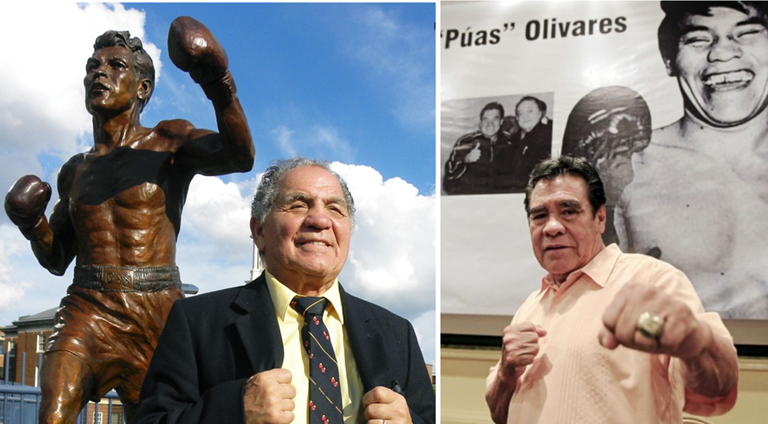
Even after his retirement in 1962, DeMarco remained a fixture in Boston’s sporting consciousness. His career, and his connection to the city, have been honored with a statue in Boston’s North End and a street named “Tony DeMarco Way”.
DeMarco’s fighting style was unafraid, direct, and continually seeking engagement. As he once described himself, he was “mainly a slugger,” but one whose slugging power was tempered by competitiveness.
“Rockabye” Rubén Olivares: Mexico’s “Knocker Outer” Icon
Born January 14, 1947, in Mexico City, Rubén Olivares Avila rose from the capital’s tough streets to become one of the most feared punchers in boxing history. His story begins in Colonia Bondojo, where early scrapes and gym fights foreshadowed an extraordinary professional career.
Olivares made his professional debut on January 4, 1965, knocking out Isidro Sotelo in the first round. By the time he had amassed a record of 52–0–1, he earned a title shot against bantamweight champion Lionel Rose of Australia. On August 22, 1969, Olivares fulfilled that opportunity with a fifth-round knockout to claim the WBA and WBC bantamweight titles; a victory that introduced the world to “Rockabye” Ruben along known as “El Púas”.
Olivares defended his belts and, despite setbacks, including a title loss to compatriot Chucho Castillo, he proved himself by regaining the bantamweight championship. His tenure was punctuated by a run of decisive victories and unforgettable exchanges.
Beyond bantamweight, Olivares moved to featherweight and continued his success. In July 1974, he knocked out Zensuke Utagawa to win the vacant WBA featherweight title. Later, in June 1975, he took the WBC featherweight crown with a second-round knockout of “Schoolboy” Bobby Chacón, a win that stands among the most dramatic in his storied career.
Across 105 professional fights, Olivares compiled a remarkable 89–13–3 record with 79 knockouts, demonstrating one of the sport’s most formidable knockout percentages. His signature left hook and devastating punching power made him a constant crowd favorite and a nightmare for opponents in two weight classes.
Olivares’s drew large audiences in the United States and Mexico alike. With well over a dozen fights at LA’s Forum in Inglewood, he helped establish the venue as the Madison Square Garden of the West Coast.
Olivares was inducted into the International Boxing Hall of Fame in 1991, as deserving as anyone who ever laced on gloves.
Twin Legacies Built on Power, Heart, and Crowd Connection
Tony DeMarco and Rubén Olivares were born on the same date but in very different worlds. DeMarco’s pugilism was steeped in the tradition of mid-20th-century American welterweights — toe-to-toe fighters with local followings and national resonance. Olivares carried the hopes of a nation known for warrior boxers, smashing through two weight classes with a menacing arsenal.
Both men fought in eras when championships were not merely belts but badges of regional pride. DeMarco represented Boston’s immigrant neighborhoods with grit and guile. Olivares became Mexico’s embodiment of power, charisma, and knockout artistry.
On January 14th we pay tribute to both Tony De Marco and Rubén Olivares.
To comment on this article in the Fight Forum, please CLICK HERE.
Side Note: I had a chance to meet both champions. We spent some time with Tony DeMarco in Boston. Charismatic guy. Met Rubén Olivares when I was invited by director Brad Little to the opening of “Toy Tiger”, the story of world contender Art Hafey, which was a more than enjoyable watch. Brad was kind enough to preview an early version of the documentary at my home months before and I must say the changes took it from a great product to an even better one. As for meeting Rubén, I grew up staring at him on the cover of boxing magazines and got to see that huge grin up close. Another charismatic guy. I’m starting to think that charisma might be a prerequisite for becoming champion.
-Dino da Vinci