Featured Articles
Two Birthdays, Two Eras: Laila Ali and Frank Klaus in Boxing History

Two Birthdays, Two Eras: Laila Ali and Frank Klaus in Boxing History
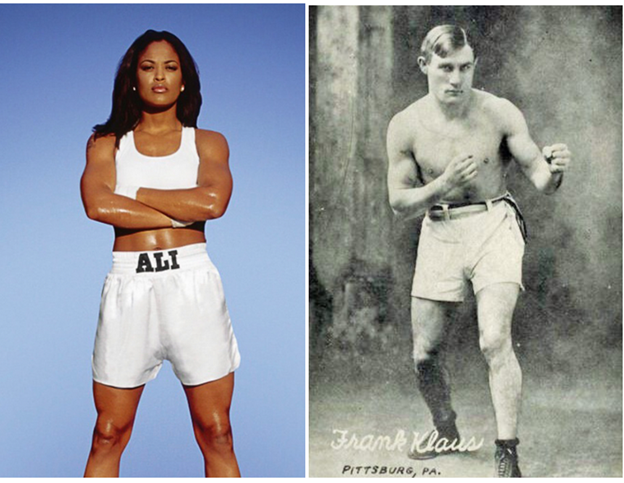
December 30 connects two boxing lives shaped by very different eras but governed by the same unforgiving standards. Laila Ali and Frank Klaus were separated by nearly a century, fought under entirely different rulesets and expectations, and faced vastly different public pressures, yet both built careers defined by credibility rather than myth, durability rather than spectacle, and records that have endured careful historical scrutiny.
Carrying a Name, Building a Record
Born on December 30, 1977, Laila “She Bee Stingin'”Ali entered professional boxing carrying a surname that guaranteed attention but offered no protection inside the ring. Ali compiled a professional record of 24 wins without a loss, with 21 of them ending early, and held world titles recognized by the WBC, WIBA, IWBF, and IBA. All but the WBC were upstart sanctioning bodies. Her career unfolded during a period when women’s boxing was still fighting for consistent television exposure and institutional legitimacy, yet Ali operated as a championship-level professionalism from the outset. She defeated established fighters such as Christy Martin and Jacqui Frazier-Lyde (the daughter of Smokin’ Joe Frazier), unified titles, and consistently fought at or near the top of the division. Ali retired in 2007 while still undefeated, a decision that preserved both her health and the integrity of her record. Her legacy rests not on longevity alone but on control — she dictated terms, chose her exit, and left behind a résumé that requires no revision or contextual apology.
Fighting Often, Fighting Everyone
Nearly ninety years earlier, on December 30, 1887, Frank “The Braddock Bearcat” Klaus was born in Turtle Creek, Pennsylvania, into a boxing world governed by survival as much as skill. Klaus fought during the early twentieth century, an era when middleweights were expected to fight often, accept punishing schedules, and prove championship status through opposition rather than belts. BoxRec documents Klaus as a highly active professional who faced many of the strongest fighters of his time, including Stanley Ketchel, Billy Papke, Jack Dillon, Sailor Ed Petroskey, Eddie McGoorty, and Georges Carpentier. In 1912 and 1913, Klaus’s victories and standing among his peers led to his recognition as the World Middleweight Champion, a designation supported by historical consensus and acknowledged by the International Boxing Hall of Fame. His reign was defined by physical strength, pressure fighting, and durability, qualities that allowed him to compete repeatedly at the highest level in an unforgiving environment.
Klaus’s career reached its turning point on October 11, 1913, when he lost by knockout to George Chip, the only stoppage defeat of his professional career. That bout effectively marked the end of his championship status, and his career soon concluded in a sport that offered no long-term security for its fighters. Records from the era vary due to newspaper decisions and inconsistent documentation, but Klaus’s body of work remains firmly established, and his induction into the International Boxing Hall of Fame in 2008 affirmed his standing as one of the most legitimate middleweight champions of boxing’s formative years. There are variants in Klaus’ record which show anywhere from 32-6-2 to 67-15-14.
Legitimacy Across Boxing’s Eras
The careers of Laila Ali and Frank Klaus illustrate two distinct paths to legitimacy. Ali competed in an era of global media, defined weight classes, and formal sanctioning bodies, yet still faced skepticism rooted in novelty and expectation. Klaus fought when championships were fragile, medical safeguards minimal, and reputations earned through repetition and attrition. What unites them is not style or circumstance, but the clarity of their historical footprint. Their records withstand scrutiny because they were built against credible opposition, within the accepted standards of their time.
On December 30, boxing history offers a rare symmetry. One fighter represents the modern ability to command a career on one’s own terms. The other reflects an age when survival itself was a measure of greatness. Both remind us that when the noise fades, boxing ultimately remembers those whose achievements remain verifiable, grounded, and intact.
*Historical Record Disclaimer: Due to the evolving nature of boxing rules and documentation in the sport’s early eras, records involving Pioneers and Old-Timers may reflect significant inconsistencies. Distinctions between official bouts, exhibitions, newspaper decisions, stoppages, and draws frequently varied by era, jurisdiction, and source, which may result in discrepancies within the historical record.